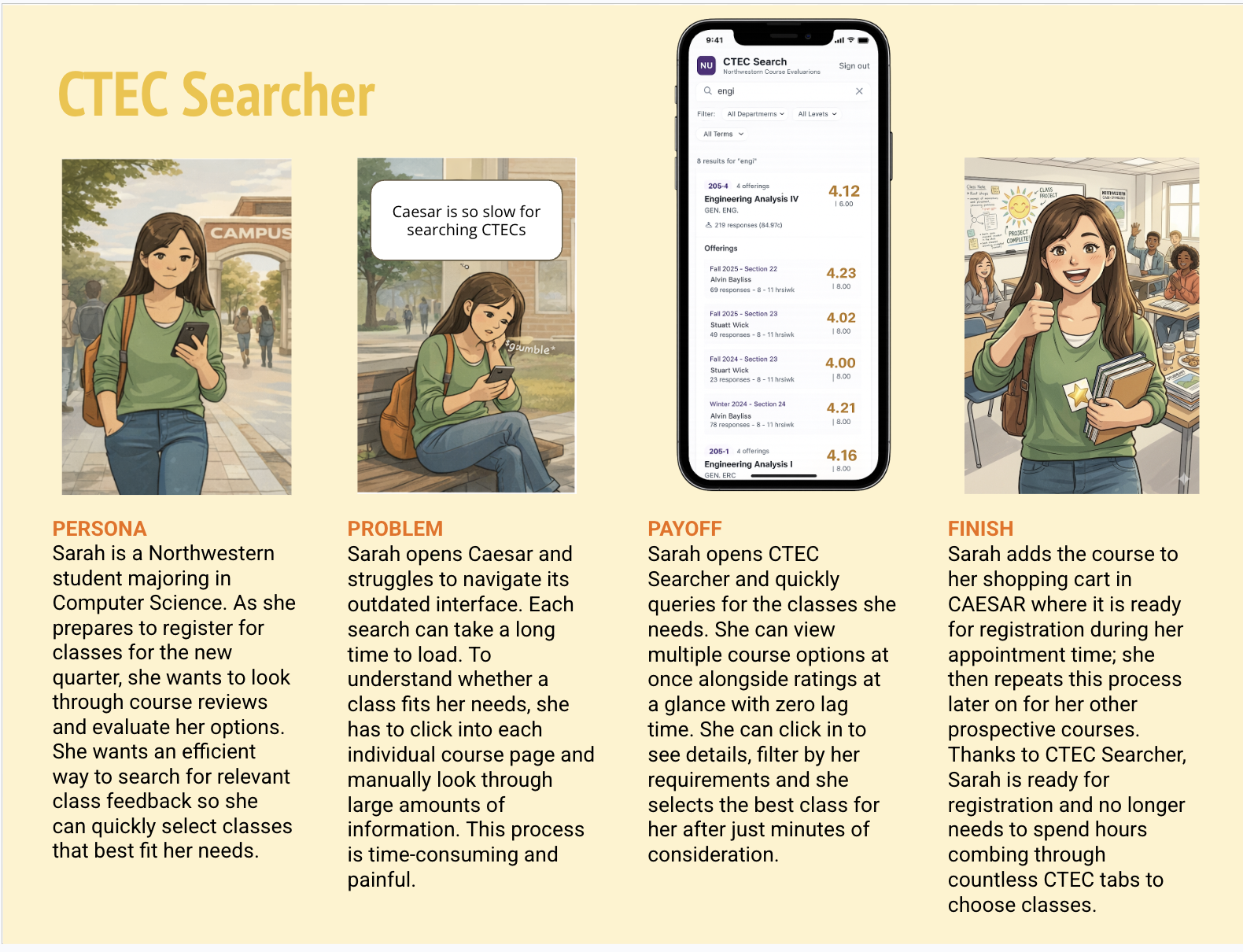
A searchable, structured database for Northwestern course and professor evaluations, turning locked PDF reports into something students can actually use.
After every class, Northwestern students fill out CTECs (Course and Teacher Evaluations): 1–6 scale ratings, structured feedback, and written comments. That data is real and detailed, but it’s locked inside long, unsearchable PDF reports. There’s no way to compare professors, filter by department, or ask a quick question like “is the workload heavy?” without reading the whole document.
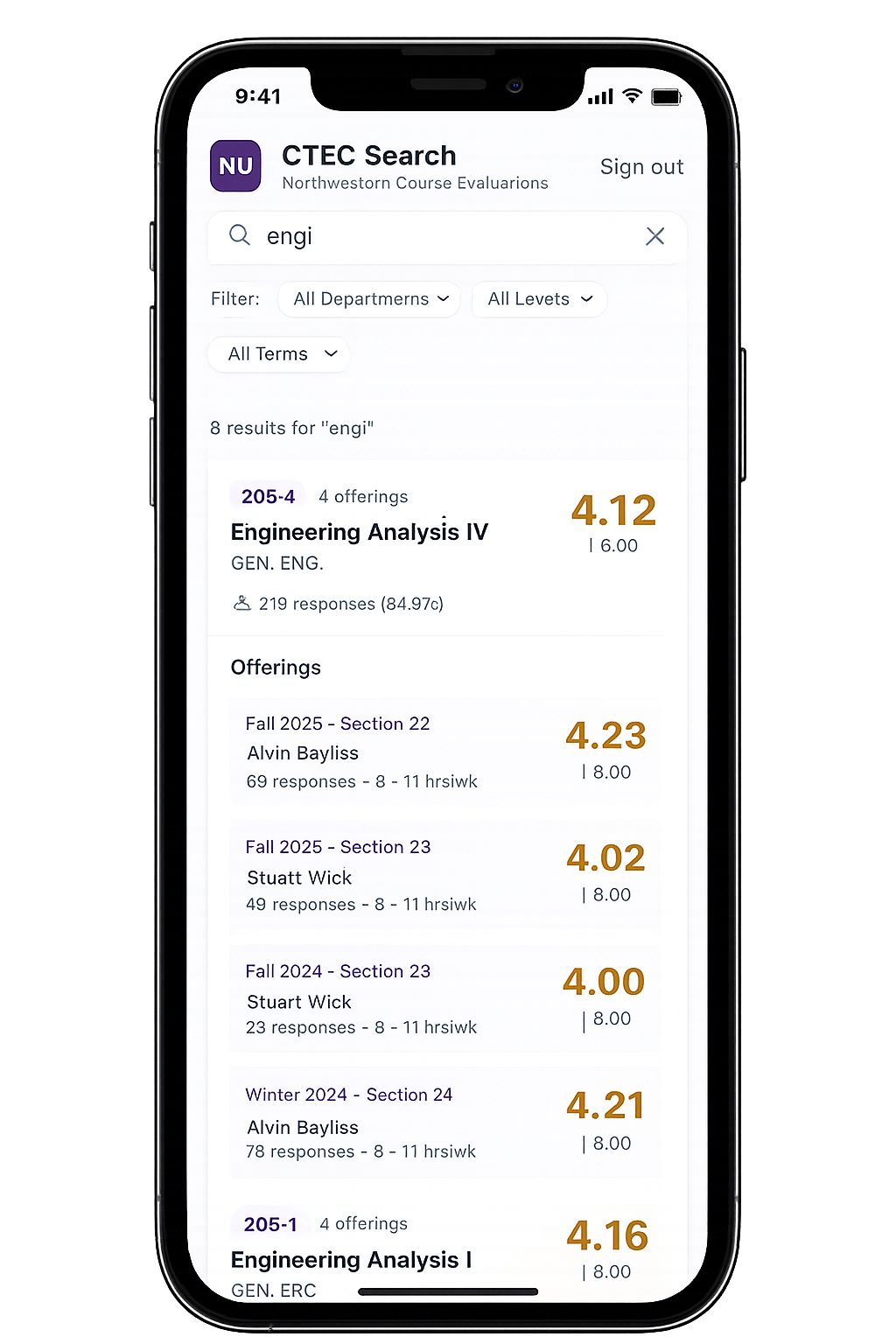
CTEC Searcher turns that PDF archive into something closer to “RateMyProfessor, but structured and data-driven.” Students search and filter course offerings by department, level, and term, sort by any of five rating dimensions (instruction quality, course rating, amount learned, intellectual challenge, prior interest), and drill into a course page showing rating distributions, time-survey data, demographics, and raw student comments, plus an AI assistant that answers questions grounded only in that course’s actual reviews.
Rapidly search for courses, professors, or departments
Easy to read and navigate UI that quickly and clearly communicates relevant information
Use AI to summarize comments instead of reading through one by one
Figure 1: Four Panel problem statementsFigure 2: CTEC Searcher Page
Architecture
Data Model
A relational schema (Professor, Course, CourseOffering, Question, QuestionDistribution, Comment) served through Firebase Data Connect over Cloud SQL Postgres. GraphQL-defined types generate fully typed query/mutation clients consumed directly by React hooks, so the schema is the single source of truth from database to UI.
Search, Filter, Sort
Client-side search across course name, number, professor, and department, combined with department/level/term filters and rating-based sorting. Filter state lives in the URL’s search params rather than component state, so any filtered view is shareable and survives a page refresh.
RAG-Powered “Ask the Reviews”
A chat feature (Gemini 2.5 Flash) scoped to a single course’s comments: the system prompt injects only that course’s student comments as context and explicitly instructs the model to answer from those comments alone, falling back to “I couldn’t find that in the reviews” rather than hallucinating. Multi-turn conversation history is preserved across follow-up questions.
Data Ingestion
A seed pipeline parses CTEC source data into structured JSON and pushes it into production via authenticated GraphQL mutations against the Data Connect endpoint, categorizing questions (core rating vs. time-survey vs. demographic) before insertion.
Visualization
Custom rating bars and distribution charts render the 1–6 scale responses and categorical breakdowns as proportional bars, so ratings stay scannable and comparable across courses.
I worked on a 5-person team practicing agile development, contributing to the design and software development.