The primary objective is to determine how TRPV1 activation (Capsaicin) affects the neural encoding of working memory. Specifically, does disrupting dopamine signaling (via TRPV1) degrade the brain’s ability to maintain task-relevant information during the delay period?
Experimental Design
- Subjects: D1 and D2-receptor expressing mice.
- Task: A spatial working memory task requiring mice to remember a “Force Direction” (instruction) over a delay period before making a “Choice.”
- Conditions: Baseline (Vehicle 1) · Manipulation (Capsaicin/TRPV1 activation) · Recovery (Vehicle 2)
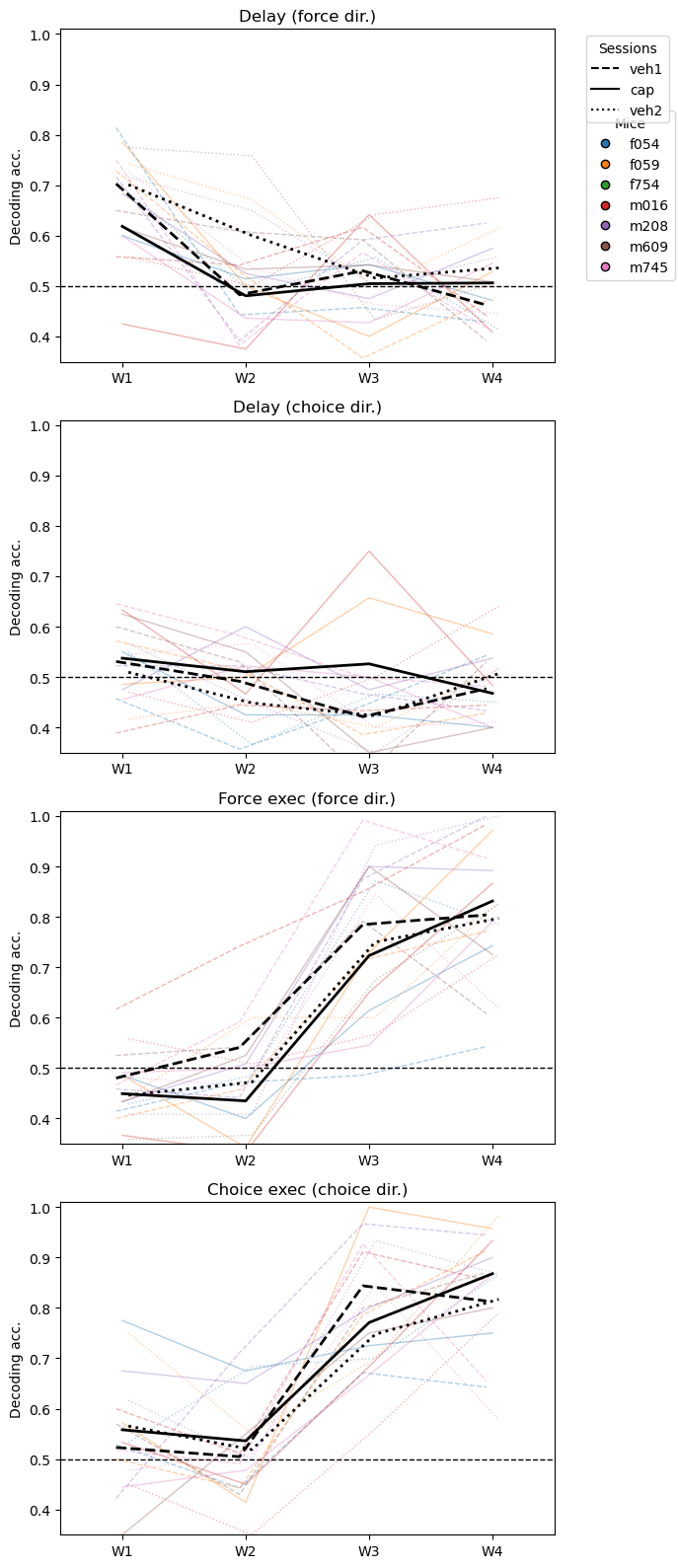
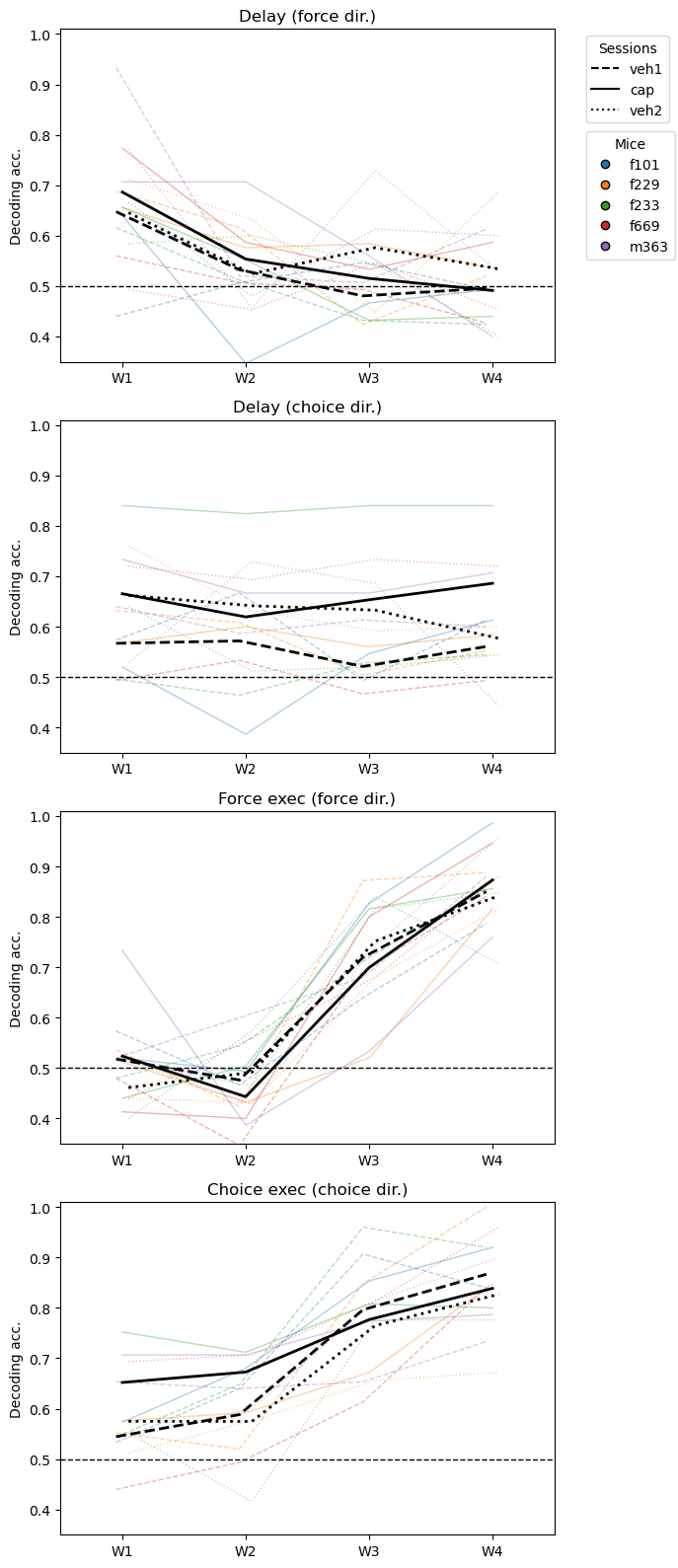
Core Methodology: Window-Based Decoding
Instead of analyzing the trial as a whole, the project uses a Time-Resolved Decoding approach to pinpoint exactly when information is lost or maintained.
- Temporal Slicing: Trials are split into discrete time windows (e.g., W1–W4) spanning the Delay and Execution phases.
- Rigorous Evaluation: Class balancing (undersampling) ensures a strict 0.5 chance level. Repeated Stratified K-Fold Cross-Validation ensures robustness.
Key Analyses
- Sensory Maintenance (Delay - Force Dir): Can the mouse hold the instruction in memory during the delay?
- Motor Planning (Delay - Choice Dir): Is the mouse planning its movement during the delay?
- Sensory History (Execution - Force Dir): Is the instruction still represented during the action?
- Motor Execution (Execution - Choice Dir): How strong is the motor signal during the actual turn?
Outcome Metrics
- Decoding Accuracy Trajectories: Plotting accuracy across windows (W1 → W4) to visualize the “memory curve.”
- Condition Effects: Comparing the accuracy curves of Vehicle vs. Capsaicin to quantify the deficit caused by the manipulation.
Technical Stack
- Core: Python, NumPy, Pandas
- Data: h5py (HDF5), scipy.io (MATLAB files)
- ML: scikit-learn (LogisticRegressionCV, PCA, Stratified K-Fold)
- Viz: Matplotlib (Accuracy curves, Weight angle heatmaps)